Zojirushi NS-TSC10 vs NS-ZCC10: Which Should You Buy? (October 2026)
In the Zojirushi NS-TSC10 vs NS-ZCC10 comparison, choose the NS-TSC10 for regular steaming or the NS-ZCC10 for rice texture choices. Their equal capacity makes your usual meals the deciding factor.
On this page (10 sections)
- Zojirushi NS-TSC10 vs NS-ZCC10: what actually changes your choice?
- Who should choose the NS-TSC10, and who should skip it?
- Who should choose the NS-ZCC10, and who should skip it?
- Is their shared capacity right for your household?
- Which cooker fits your counter and outlet?
- How should you set up either cooker for the first batch?
- How useful are their timers and keep-warm functions?
- What care will make daily use easier?
- Which common mistakes should you avoid?
- Zojirushi NS-TSC10 vs NS-ZCC10: which should you buy?
Choose the NS-TSC10 if you'll regularly steam food, or the NS-ZCC10 if rice texture matters most. In this Zojirushi NS-TSC10 vs NS-ZCC10 comparison, your usual meals matter more than the technology names.
The TSC10 suits a kitchen where one appliance needs to handle more jobs. The ZCC10 suits a household that wants specific rice programs and a choice between softer and firmer white rice.
Both use computerized fuzzy logic, so neither is a basic on/off cooker. The useful question is which set of controls will earn its place on your counter.

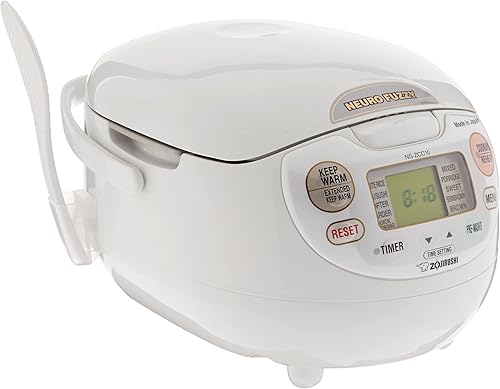 Best for particular rice eaters
Zojirushi NS-ZCC10 Neuro Fuzzy Rice Cooker
Zojirushi NS-TSC10 vs NS-ZCC10: what actually changes your choice?
The main trade-off is extra cooking functions versus rice-focused choices. Choose around a task you repeat each week, rather than a feature you might try once.
The TSC10 has Steam and Cake menus, with a steaming basket included. That gives it a clear purpose for buyers who want to prepare steamed dishes without keeping a separate steamer.
The ZCC10 offers white rice settings for regular or sushi rice, plus softer and harder choices. Its other menus cover mixed rice, porridge, sweet rice, semi-brown, brown, rinse-free and quick cooking.
Those controls make it easier to select a routine for the dish you want. They are a reason to choose the ZCC10, but they don't establish a head-to-head advantage in finished rice.
Don't choose from the words “Micom” and “Neuro Fuzzy” alone. Our guide to how Micom and Neuro Fuzzy models differ explains the terms if they are clouding your decision.
NS-TSC10 vs NS-ZCC10: match the menus to your week
Write down 3 meals you make often, then identify what the cooker needs to do for each. This turns a long feature list into a useful buying check.
For rice served beside steamed vegetables, the TSC10's extra function has a clear role. Check the manual before planning simultaneous rice cooking and steaming, since having a basket doesn't establish how those tasks can be combined.
For a week that includes firmer white rice, softer rice bowls and porridge, the ZCC10 offers more relevant choices. You have a menu to select instead of relying only on water adjustments.
If your list contains the same plain rice every time, neither headline difference may matter much. Focus on capacity, space and how often you'll use the appliance.
Who should choose the NS-TSC10, and who should skip it?
Choose the NS-TSC10 for regular steaming tasks, especially if you want to avoid storing another countertop appliance. Its extra functions make sense when you can name meals that will use them.
The basket is useful for cooks who already enjoy steamed food and want a dedicated mode for it. Follow the food amounts and water guidance in the manual so steam can circulate as intended.
The Cake menu is a secondary reason to choose this model. Buy for it only if cooker-made cakes appeal to you, rather than assuming it replaces the range of baking jobs an oven handles.
The brown, clear-coated stainless steel exterior may also fit your kitchen better. Appearance is a reasonable tie-breaker for an appliance that stays out, but it shouldn't outweigh the functions you need.
Skip the TSC10 if you already have a steamer you like and have little interest in its other extra function. In that case, the ZCC10's rice controls are more relevant if texture is your priority.
Also skip it if its deeper body makes the working area cramped. The NS-TSC10 review gives you a closer look at its features before you commit counter space.
Who should choose the NS-ZCC10, and who should skip it?
Choose the NS-ZCC10 if your household has clear rice preferences or regularly switches between rice dishes. Its menu choices are useful when you can explain why you want one setting over another.
For example, someone who prefers firmer rice with a saucy meal has a direct reason to use the harder white rice option. A household that prefers a softer bowl has a different starting point available.
Its spherical nonstick inner pan has stay-cool side handles. Those handles help with handling the pan, though hot rice and escaping steam still call for care.
Choose a sushi setting for cooking rice intended for that dish, then follow your recipe for seasoning and preparation. A menu name doesn't replace the steps that happen after the rice is cooked.
Skip the ZCC10 if you mainly want an appliance for steaming. Its strongest reasons to buy are centered on rice, so the TSC10 better matches that use.
It may also be more cooker than you need if you rarely make rice and have no interest in the extra menus. Read the NS-ZCC10 review if its rice-focused approach matches your meals.
Is their shared capacity right for your household?
Both hold up to 5.5 cups of uncooked rice, so neither gives you a larger batch. Decide whether that size suits your meals before choosing between their menus.
An uncooked capacity label describes dry rice, not the amount served into bowls. Don't compare it directly with a container measured in cooked rice portions.
Use your normal meal as the guide: how much dry rice do you prepare when rice is a side, and how much when it's the main part of dinner? Allow for guests only if those larger meals happen often.
For a small household, the maximum capacity matters less than the batches you usually cook. Check the manual's supported amounts for your chosen menu instead of assuming every program accepts any quantity up to the headline limit.
The same caution applies to mixed rice and porridge. Added ingredients and expanding or foaming mixtures can require different limits from plain rice.
If you routinely need more rice than this size allows, skip both models. The rice cooker size guide helps you plan around actual portions rather than a household label alone.
Which cooker fits your counter and outlet?
The NS-ZCC10 needs slightly less depth and height, while both have the same width. That difference matters most on shallow counters or beside other appliances.
In width, depth and height, the TSC10 measures 10-1/8 x 14 x 8-1/2 inches. The ZCC10 measures 10-1/8 x 13 x 8-1/8 inches.
Measure a working spot, not just a storage gap. You need room to open the lid, lift the pan and serve rice without reaching awkwardly around another appliance.
Allow steam to escape away from cabinet undersides and other surfaces that could be harmed by heat or moisture. Follow the placement clearances in the manual rather than using the closed-body height as your clearance guide.
Both have retractable cords and use 120-volt power. Check that the intended location has a suitable outlet within reach, and keep the cord away from hot surfaces and sink splashes.
The TSC10 is rated at 610 watts and the ZCC10 at 680 watts. Those figures don't tell you which finishes sooner or uses less electricity for a complete batch, so don't treat wattage as a speed ranking.
How should you set up either cooker for the first batch?
Start with the supplied measuring cup, the correct water guidance and a plain batch of rice. Keeping the first batch simple makes later texture adjustments easier to judge.
Wash the removable food-contact parts as directed before use. Once dry, seat the pan correctly and check that its outside and the heating area are free of water and stray grains.
The TSC10 includes a rice measuring cup, while the ZCC10 includes regular and rinse-free cups. For the ZCC10, use the cup that matches the rice preparation method.
Don't swap in a household measuring cup and assume the inner-pan markings still match. Those markings and the supplied rice cup form a measuring system.
Rinse rice when its packaging and the cooker instructions call for it. Drain it consistently, since extra rinse water can change the amount of water in the pan.
Level the rice and check water markings with the pan sitting flat. A tilted pan or a pile of rice on one side makes the reading less useful.
Select the menu before starting, then let the cycle finish without repeatedly opening the lid. Follow any resting instructions before gently fluffing and serving.
For the full routine, keep our guide to using a Zojirushi rice cooker nearby for your first few meals.
How useful are their timers and keep-warm functions?
Both provide automatic and extended keep-warm, reheating and 2 delay settings. Scheduling is therefore a shared benefit, rather than a strong reason to favor either model.
Both also have LCD controls and a choice of melody or beep signals. If your meals follow a regular schedule, learning the timer matters more than choosing between these shared features.
Before setting a delay, confirm what the displayed time means in the manual. Don't assume the clock is showing a countdown or a starting time.
Check that the selected menu permits delayed cooking. Use only ingredients and waiting periods allowed by the instructions, especially when a recipe adds anything beyond rice and water.
Keep-warm is useful when people eat at different times, but avoid preparing much more rice than you need. Longer holding can affect texture even when you follow the appliance's directions.
For leftovers, use a suitable cooling and storage routine rather than treating the cooker as a storage container. Reheating is a separate step from keeping freshly cooked rice warm.
What care will make daily use easier?
Clean the pan, inner lid and other washable parts as directed after use, and keep the heating area free of debris. A quick routine is easier than removing dried starch later.
Let parts cool before cleaning. Use a soft sponge and a suitable mild cleaner on nonstick surfaces, avoiding abrasive pads and metal scraping tools.
The TSC10 calls for hand washing. The ZCC10 has a detachable washable inner lid, while its exterior care calls for wiping with a damp cloth.
Don't immerse the powered body or let water collect around its controls. Dry washed parts before putting the cooker back together.
Use the supplied spatula or another utensil suitable for nonstick cookware. Serve from the pan gently rather than using it as a bowl for forceful mixing or scraping.
For stuck rice, soak the removable pan as the manual permits instead of chipping at the surface. Our rice cooker cleaning guide covers a practical routine for starch, residue and removable parts.
Which common mistakes should you avoid?
Avoid changing several things at once when a batch is too soft or too firm. Keep the rice amount, draining method and menu steady, then make one small adjustment within the manual's guidance.
On the ZCC10, try the intended texture option before making a large water change. Otherwise, you can overshoot the result by changing both the program and water amount together.
Don't expect the same water routine to suit every rice variety. Follow the guidance for the grain and menu you are using, especially when moving between white and brown rice.
Avoid filling a mixed dish to a plain-rice limit without checking the recipe instructions. Vegetables, seasonings and other additions change what is in the pan.
Don't choose the quick menu solely because dinner is late and assume the result will match your usual program. Learn how it fits your preferred rice before relying on it for an important meal.
Finally, resist buying for every possible future dish. An extra menu earns its place when it solves a regular need, not when its name sounds appealing.
Zojirushi NS-TSC10 vs NS-ZCC10: which should you buy?
Pick the NS-TSC10 if steaming is the extra job you need. Pick the NS-ZCC10 if choosing rice texture and switching rice styles are part of your normal cooking.
Before ordering, settle 3 points: your usual batch fits, the cooker has a safe working spot, and its main advantage is something you'll use. If any of those fail, choose another size or feature set.
For the Zojirushi NS-TSC10 vs NS-ZCC10 decision, neither capacity nor the shared timing functions breaks the tie. Your next useful step is to compare those needs with our Zojirushi cooker guide if neither model feels like a clear fit.
Frequently asked questions
What is the difference between the Zojirushi NS-TSC10 and NS-ZCC10?
The main difference is steaming versatility versus rice menu choice; the NS-TSC10 includes a Steam menu and basket, plus a Cake menu. The NS-ZCC10 provides white rice texture choices and programs for several rice styles; both have the same uncooked rice capacity and similar scheduling functions.
Can the Zojirushi NS-TSC10 steam food?
Yes, the NS-TSC10 has a Steam menu and includes a steaming basket; it suits buyers who want a separate steaming option without another appliance. Follow the manual for water amounts, food placement and timing, and confirm any instructions for combining steaming with rice cooking before doing so.
Does the NS-ZCC10 cook brown rice?
Yes, the NS-ZCC10 has a dedicated brown rice menu, along with a separate semi-brown option. Select the menu and water guidance that match your rice rather than using the white rice routine; brown rice generally needs a different cooking approach, so allow enough time for the selected cycle.
Are the NS-TSC10 and NS-ZCC10 the same size?
No, their outer dimensions differ despite their equal rice capacity; the NS-TSC10 measures 10-1/8 inches wide, 14 inches deep and 8-1/2 inches high. The NS-ZCC10 measures 10-1/8 inches wide, 13 inches deep and 8-1/8 inches high; leave extra space for lid access and escaping steam.
Which Zojirushi model should I buy?
Buy the NS-TSC10 if steaming will be part of your normal meal routine; choose the NS-ZCC10 if you want more control over white rice texture and cook several rice styles. If neither feature matters, decide whether either cooker offers enough benefit over a simpler model for your meals.


