6 Best Small Rice Cookers (October 2026)
The best small rice cookers include the Zojirushi 3-Cup Micom Rice Cooker for solo meals, the Toshiba Mini 3-Cup Rice Cooker for varied meal prep, and the Zojirushi NL-BAC05SB 3-Cup Micom Rice Cooker for staggered mealtimes.
On this page (10 sections)
- How we chose these small rice cookers
- Small rice cooker comparison
- Which small rice cooker fits your kitchen?
- How much rice do you usually cook?
- Which rice types and settings matter most?
- What features help in a compact kitchen?
- How do you set up a small rice cooker for consistent rice?
- How do you keep the pot and steam parts clean?
- Which common mistakes are worth avoiding?
- Which small rice cooker should you choose?
The Zojirushi 3-Cup Micom Rice Cooker is the best small rice cooker for solo meals and varied grains because it supports batches as small as 1/2 cup of rice or oats. Toshiba suits broader meal prep, while Tiger suits a simple daily rice routine.
Buy for the amount you usually eat, then check the space available. A compact appliance can still produce several portions, and its smallest supported batch matters as much as its maximum capacity.
Our picks at a glance
-
1

-
2

-
3
 Best for staggered mealtimes
Zojirushi NL-BAC05SB 3-Cup Micom Rice Cooker
8.1/10 our score
See it on Amazon
- 4
 Check it
Cuckoo CR-0375F 6-Cup Fuzzy Logic Rice Cooker
Best for busy weeknights - 5
 Check it
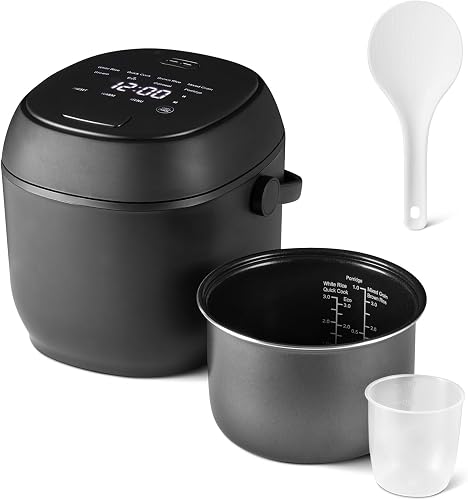
Amazon Basics Small 3-Cup Rice Cooker
Best for narrow counters - 6
 Check it
Tiger JNP-0550 3-Cup Rice Cooker
Best for simple daily cooking
How we chose these small rice cookers
We compared batch flexibility, grain menus, meal timing and storage needs to find options for different small households. UnhurriedChoice's recommendations reflect those features and the routines they support.
A cooker earns its place on a small counter by solving a daily task. For one person, that may mean making a modest portion; for a couple, it may mean holding rice while the rest of dinner comes together.
We also considered cleaning access and the work involved in putting the appliance away. Extra menus have value only if you use them, so the simplest model can be the right choice for a steady white rice routine.
Small rice cooker comparison
Choose the first Zojirushi for an explicit small-batch minimum, Toshiba for flexible meal prep, or Tiger for fewer controls. The other picks address warm holding, busy evenings and narrow counter space.
Capacity labels need careful reading: uncooked rice and cooked rice describe different amounts. Several models below have the same maximum yield despite different wording in their names.
| Product | Best for | Capacity | Smallest stated batch | Storage | Our score |
|---|---|---|---|---|---|
| Zojirushi 3-Cup Micom Rice Cooker | solo meals | 3 cups | 1/2 cup of rice or oats | Fold-down handle and retractable power cord | 9.1 |
| Toshiba Mini 3-Cup Rice Cooker | varied meal prep | 3 cups uncooked | 8.5 | ||
| Zojirushi NL-BAC05SB 3-Cup Micom Rice Cooker | staggered mealtimes | 3 cups | 8.1 | ||
| Cuckoo CR-0375F 6-Cup Fuzzy Logic Rice Cooker | busy weeknights | 3 cups uncooked / 6 cups cooked | 8.0 | ||
| Amazon Basics Small 3-Cup Rice Cooker | narrow counters | 3 cups uncooked / 6 cups cooked | 7.1 | ||
| Tiger JNP-0550 3-Cup Rice Cooker | simple daily cooking | 3 cups dried rice | Retractable power cord | 7.0 |
Which small rice cooker fits your kitchen?
Match each cooker to your usual meals and the feature you'll use most. These picks appear in score order, but a lower-ranked model can be the better fit for a specific routine.
1. Zojirushi 3-Cup Micom Rice Cooker
Zojirushi 3-Cup Micom Rice Cooker
- 3-cup capacity
- Cooks as little as 1/2 cup of rice or oats
- Brown rice, steel-cut oatmeal and long-grain white settings
- Fold-down handle and retractable cord
The stated half-cup minimum suits solo portions, while separate grain menus support a varied weekly menu.
Pros
- Stated minimum suits small meals
- Separate menus for different grains
- Handle and cord simplify storage
Cons
- Requires hand washing
- More controls than a one-button cooker
Choose this Zojirushi if you cook for yourself or a partner and want clear support for modest portions. Its half-cup minimum is the strongest reason to choose it over another compact model with an unspecified lower batch limit.
Its separate menus cover brown rice, GABA brown rice, steel-cut oatmeal and long-grain white rice. That suits a kitchen where breakfast oats and dinner rice share one appliance, without asking one cooking program to handle every grain.
The GABA brown program includes a 2-hour activation stage, so it belongs in a planned meal routine. Choose the regular brown rice menu when you don't want that added stage, following the instructions for each program.
A fold-down handle and retractable cord help if you put the cooker away after meals. Let it cool and dry before moving it into a cabinet.
Skip this pick if you mainly want one button for white rice or regularly need larger batches. Its menu choices make more sense when you rotate grains than when you repeat the same meal every day.
2. Toshiba Mini 3-Cup Rice Cooker
Toshiba Mini 3-Cup Rice Cooker
- 3 cups uncooked capacity
- 8 cooking functions
- 24-hour delay timer
- Removable steam valve and vent cap
Choose Toshiba when you want rice, porridge and other dishes from one appliance, with a timer for planning meals.
Pros
- Menus extend beyond rice
- Delay timer supports meal planning
- Steam parts come off for cleaning
Cons
- Inner pot needs hand washing
- 11.6-inch width needs counter space
Choose Toshiba if you want a rice cooker that can also take on other meal-prep jobs. Its 8 functions include white rice, quick cook, brown rice, mixed grain, slow cook, porridge, cake and egg.
That range suits someone who will use the appliance across the week. A porridge breakfast or a slow-cooked dish gives the extra controls a purpose beyond occasional novelty.
The 24-hour delay timer helps schedule suitable recipes, while keep warm and reheat offer flexibility after cooking. Follow the manual's timing guidance, and don't leave perishable ingredients sitting unrefrigerated for a delayed start.
Its removable steam valve and vent cap give you access to areas where starchy residue can collect. The non-stick pot needs mild soap and a soft cloth, so plan on a short hand-washing routine.
Skip Toshiba if a narrow gap is your main constraint: its body is 11.6 inches wide. Also choose a simpler cooker if you won't use the additional programs or scheduling controls.
3. Zojirushi NL-BAC05SB 3-Cup Micom Rice Cooker
Zojirushi NL-BAC05SB 3-Cup Micom Rice Cooker
- 3-cup capacity
- Triple heater
- Extended keep warm setting
- Removable steam vent cap
Automatic and extended keep warm settings suit households whose members serve themselves at different times.
Pros
- Heats from bottom, side and top
- Two keep warm options
- Dedicated quinoa and white/sushi menus
Cons
- 12.88-inch depth needs counter space
- Weighs 6 pounds when moving it into storage
Choose the NL-BAC05SB if cooking and serving happen at different times in your household. Its automatic and extended keep warm settings give warm holding a larger role than it has on a basic cooker.
Zojirushi uses a lower temperature in the extended setting to limit drying. Use the mode and holding limits specified in the manual rather than assuming every cooked dish belongs on extended keep warm.
The triple heater supplies heat from the bottom, sides and top. Its 2.5 mm non-stick inner pan and menus for white/sushi rice, brown rice, long-grain white rice, steel-cut oatmeal and quinoa round out the cooking options.
This is a sensible alternative to the first Zojirushi when quinoa and warm holding matter more than an explicit half-cup minimum. Don't assume the two models share every batch limit just because both are compact Micom cookers.
Skip it if your counter is shallow or you carry appliances in and out daily. At 12.88 inches deep and 6 pounds, it needs a deliberate storage spot.
4. Cuckoo CR-0375F 6-Cup Fuzzy Logic Rice Cooker
Cuckoo CR-0375F 6-Cup Fuzzy Logic Rice Cooker
- 3-cup uncooked and 6-cup cooked capacity
- Fuzzy logic cooking
- Quick white rice mode
- Self-clean setting and removable lid
A quick white rice mode, timer and accessible cleaning parts suit frequent cooking during a busy week.
Pros
- Quick mode for white rice
- Fuzzy logic adjusts time and temperature
- Self-clean setting supplements routine care
Cons
- Weighs 8 pounds when moving it into storage
- Requires hand washing
Choose Cuckoo if you often start dinner late and want a quick white rice option alongside broader grain menus. Cuckoo gives 26–28 minutes for quick white rice, but follow its instructions for the amount and conditions that mode supports.
Its other options include brown rice, quinoa, multigrain and oatmeal. Fuzzy logic adjusts cooking time and temperature, while the timer and warming mode help fit rice around the rest of dinner.
The self-clean setting and removable lid are useful for frequent cooking. Self-clean supplements regular care; you still need to remove food residue and hand-wash the appropriate parts.
Despite the 6-cup wording in its name, this cooker has a 3-cup uncooked capacity. It doesn't offer more maximum cooked rice than the Toshiba, Amazon Basics or Tiger models here.
Skip it if your main goal is easy carrying between a shelf and the counter. Its 8-pound weight makes a permanent worktop spot more appealing, particularly if you cook rice most evenings.
5. Amazon Basics Small 3-Cup Rice Cooker
Amazon Basics Small 3-Cup Rice Cooker
- 3-cup uncooked and 6-cup cooked capacity
- 8 cooking functions
- 24-hour preset
- Ceramic non-stick coating
Its 7.67-inch width suits a narrow counter spot, with grain menus and a ceramic-coated aluminum inner pot.
Pros
- Narrow body saves counter width
- Preset and automatic keep warm
- Includes steam and porridge menus
Cons
- Requires hand washing
- Several menus may be unnecessary for basic white rice
Choose Amazon Basics if counter width is your limiting measurement and you still want several grain programs. Its body measures 7.67 inches wide, 9.37 inches deep and 7.87 inches tall.
The menu covers white rice, quick cook, brown rice, mixed grain, steam, eco, oatmeal and porridge. That makes it a useful candidate for a small kitchen where the cooker may handle both breakfast and dinner.
Fuzzy logic adjusts time and temperature, and a 24-hour preset supports planned cooking. Automatic keep warm lets you finish a side dish or sauce before serving the rice.
The inner pot is aluminum with a ceramic non-stick coating. Treat it as a coated pan: use gentle utensils and wash it by hand with mild soap rather than scrubbing stuck grains with an abrasive pad.
Skip this model if you specifically need a confirmed half-cup batch or a single-button interface. A narrow body solves a space problem, but it doesn't establish the smallest portion the cooker can prepare.
6. Tiger JNP-0550 3-Cup Rice Cooker
Tiger JNP-0550 3-Cup Rice Cooker
- 3 cups dried rice yields about 6 cups cooked
- Single push-button operation
- Keep warm up to 12 hours
- Retractable power cord
A single push button suits a repeatable rice routine, while the removable inner lid helps with regular cleaning.
Pros
- Single push-button operation
- Automatic keep warm
- Removable inner lid and retractable cord
Cons
- Fewer cooking options than the multi-menu picks
- Requires hand washing
Choose Tiger if you want to measure rice, add water and press one button. Its conventional controls suit someone who repeats a familiar rice routine and doesn't want to select a program at each meal.
The cooker switches to automatic keep warm for up to 12 hours. That provides serving flexibility, though cooking closer to mealtime can reduce the time rice spends sitting warm.
Its retractable cord helps with storage, and the detachable inner lid gives you access for cleaning. The coated inner pot has measurement markings, so use the supplied rice cup with those marks.
Tiger makes this model in Japan, and it is UL certified for use on 120-volt power. Those details may matter if country of manufacture or certification is part of your buying checklist.
Skip it if you regularly switch between brown rice, oatmeal and mixed grains and want dedicated programs. The multi-menu picks offer more guidance for that routine, while Tiger's appeal is its simple control.
How much rice do you usually cook?
Choose a cooker whose minimum and maximum batches cover your normal meals. Buying around occasional guests can leave you making more rice than you want on ordinary weekdays.
Match a small rice cooker to your portions
Start by measuring the dry rice you already use for a typical meal. Rice served beside vegetables and protein fills a different role from rice that forms most of a bowl.
The Toshiba, Cuckoo, Amazon Basics and Tiger accept 3 cups of uncooked or dried rice and yield about 6 cups cooked. That is useful batch capacity, but a solo cook may rarely need to fill the pot.
The first Zojirushi explicitly supports 1/2 cup of rice or oats. For the other models, confirm the manual's minimum for your grain before buying for very small portions.
Our guide to choosing a rice cooker covers size, pot and settings. The rice cooker size guide helps put serving needs in context.
Use the cooker's measuring system
Use the supplied rice cup and the matching water lines as a pair. A rice-cooker cup may differ from a standard US measuring cup, so mixing systems can change the rice-to-water balance.
If you add 2 supplied cups of dry rice, follow the instructions for the corresponding grain and water mark. Don't assume that means adding 2 cups of water.
Capacity limits can also change by program. Porridge and foods that foam may have lower fill limits than plain white rice, so the largest rice batch isn't a universal allowance for every recipe.
Which rice types and settings matter most?
Choose dedicated menus for the grains you eat often, then consider extra cooking functions. A long list of programs adds little if your weekly meals never use them.
Brown rice needs a different approach from white rice because the outer bran layer affects water absorption and cooking time. Select the correct program and water marks instead of relying on a white rice cycle.
Our brown rice cooker picks are useful if brown rice is your main staple. Compare that need before choosing around cake, egg or other occasional modes.
For sushi meals, the NL-BAC05SB has a white/sushi menu. The cooker prepares the rice, while seasoning and cooling happen afterward; our sushi rice cooker guide covers models for that use.
Oatmeal also needs the right instructions. Steel-cut oats and rolled oats aren't interchangeable, and a dedicated steel-cut program should be used with its specified grain, amount and water level.
Fuzzy logic can adjust heat and timing during cooking, but you still choose the grain, measure accurately and respect batch limits. It cannot compensate for the wrong program or an overfilled pot.
What features help in a compact kitchen?
Prioritize usable clearance and easy storage before comparing extra controls. A cooker that fits on a shelf may still be awkward to fill, open or clean there.
Measure width, depth and height, then allow space for the lid to open fully. Check that you can lift out the inner pot without striking a cabinet above it.
Steam needs a clear path away from cabinet undersides and nearby objects. Place the cooker on a stable, heat-resistant surface and follow its clearance instructions.
Retractable cords help when you store an appliance between meals. A detachable cord can also make packing away easier, but let the cooker cool before handling it and keep the connector dry.
Consider weight if storage means lifting from a low cabinet or reaching overhead. A slightly larger permanent counter spot may be easier to use than a tight shelf that requires carrying the cooker every day.
A delay timer and keep warm solve different problems. The timer schedules cooking, while keep warm holds the finished rice; choose the one that matches where your meal routine usually needs flexibility.
How do you set up a small rice cooker for consistent rice?
Start with clean parts, accurate measures and the correct menu. Keep the first few batches simple so you can learn how your rice behaves without changing several things at once.
Before the first batch
Read the instructions for washing removable parts, assembling the steam vent and any first-use procedure. Remove packing material, and never immerse the cooker body or power connection.
Check that the outside of the inner pot and the heating area are clean and dry before seating the pot. A stray grain beneath it can keep it from resting evenly.
Place the appliance where the cord won't cross a walkway or hang where it could be pulled. Keep hands and your face away from the vent during cooking and when opening the lid.
Measure, rinse and select
Measure dry rice first, then rinse it as directed for that rice. A separate bowl or fine-mesh strainer helps avoid rubbing grains against the pot's coating.
Drain after rinsing, add the rice to the pot and use the correct water guide. Check the level on a flat surface rather than while holding the pot at an angle.
Select the grain program before starting. Avoid opening the lid to check progress, since releasing steam changes the cooking conditions.
Finish before adjusting
Follow the manual's resting instructions, then gently fluff the rice before serving. Judge the texture after that step rather than from the damp surface immediately after cooking.
If the rice is consistently firmer or softer than you prefer, make a small water adjustment within the instructions. Keep the grain, batch size and menu unchanged so you know what caused the difference.
How do you keep the pot and steam parts clean?
Clean food-contact parts after each use, once they are safe to handle. Starchy film builds up in lids and vents as well as in the bowl.
Remove leftover rice, then wash the coated pot with mild soap and a soft sponge. Soften stuck grains with water rather than scraping them with metal or using an abrasive cleaner.
Clean removable lids, caps and valves according to the model's instructions. Let washed parts dry before reassembly, and wipe the cooker body without allowing water into electrical areas.
The Cuckoo's self-clean program doesn't replace removing food from the pot and lid. Treat it as an additional care step, with the required water amount and procedure.
Our rice cooker cleaning guide explains the routine in more detail. Check the model manual before putting any removable part in a dishwasher.
Which common mistakes are worth avoiding?
Avoid overfilling, mixing measuring systems and using the wrong grain program. These mistakes can spoil a batch even when the cooker has automatic controls.
Don't treat every menu as permission to use the full white rice capacity. Thick porridge, foaming grains and mixed recipes need their own limits.
Don't choose a quick cycle whenever you are short on time without checking which rice it supports. A quick white rice program isn't a shortcut for every grain.
Don't use a long delay with ingredients that need refrigeration. Follow the recipe and appliance guidance, especially for dishes containing meat, eggs or dairy.
Don't leave cooked rice sitting in a switched-off cooker for later meals. Keep it hot using the proper function or cool leftovers promptly and refrigerate them.
Don't protect the counter footprint at the expense of everyday access. If you must move several objects before opening the lid, the cooker probably needs a better spot.
Which small rice cooker should you choose?
Choose your small rice cooker around the job it must do most often. Set your batch range and available space first, then use these distinctions to make the final choice.
- For solo portions: choose the Zojirushi 3-Cup Micom when an explicit half-cup minimum matters.
- For varied meal prep: choose Toshiba when you'll use programs beyond rice and want a delay timer.
- For staggered meals: choose the Zojirushi NL-BAC05SB when warm holding is a regular part of dinner.
- For busy evenings: choose Cuckoo when quick white rice and accessible cleaning parts fit your routine.
- For a narrow counter: choose Amazon Basics when width is the deciding measurement.
- For a simple daily habit: choose Tiger when one-button cooking meets your needs.
If capacity is still unclear, use our rice cooker size guide before ordering. For controls and pot choices, read how to choose a rice cooker.
If your usual batch exceeds these compact models, compare our broader best rice cooker picks. A small appliance is useful only when it can comfortably handle the meals you actually make.
Our top 3 picks at a glance
-
1
-
2
-
3
Best for staggered mealtimes
Zojirushi NL-BAC05SB 3-Cup Micom Rice Cooker
8.1/10 our score
See it on Amazon
Frequently asked questions
What size rice cooker is best for one or two people?
A 3-cup uncooked rice cooker is a practical starting point for one or two people, provided it supports your usual minimum batch; the Zojirushi 3-Cup Micom Rice Cooker can prepare as little as 1/2 cup of rice or oats. Choose around everyday portions rather than occasional guests.
Does a 3-cup rice cooker make 3 cups of cooked rice?
No, a 3-cup rice cooker may describe uncooked capacity, which produces more rice after cooking; Toshiba, Cuckoo, Amazon Basics and Tiger here accept 3 cups uncooked or dried rice and yield about 6 cups cooked. Use the supplied measuring cup and the matching water marks rather than assuming a standard kitchen cup.
Can a small rice cooker make brown rice?
Yes, both Zojirushi picks and the Toshiba, Cuckoo and Amazon Basics models have brown rice options. Follow the brown rice water marks and batch limits because they can differ from white rice instructions; a small pot doesn't mean a short cycle, so allow enough time for the selected grain.
Is fuzzy logic useful in a small rice cooker?
Yes, fuzzy logic is useful when you want automatic adjustments to cooking time and temperature, especially across different grains; it doesn't remove the need for correct measuring or menu selection. Our fuzzy logic rice cooker guide explains the controls and helps you decide whether they fit your routine.
How do you choose between a small rice cooker and a larger one?
Choose a small cooker when its everyday batch range covers your meals without forcing leftovers; move up in size if you regularly need more than its allowed maximum, including lower limits for porridge or other grains. Our rice cooker size guide helps translate household meals into capacity needs.


